
From the First Electronic Microrefrigerator to ŚŪNYA
Quantum computing has advanced through a series of remarkable scientific breakthroughs. First came the fundamental physics of superconducting circuits. Then came the algorithms that demonstrated the extraordinary computational power of quantum systems. The next challenge is infrastructure—building technologies that enable quantum computers to scale beyond today’s laboratory systems.
One of the highlights of Quantum.Tech 2026 was the opportunity to meet Dr. John Martinis, recipient of the 2025 Nobel Prize in Physics for pioneering discoveries that established macroscopic quantum behavior in superconducting electrical circuits. Those discoveries laid the foundation for superconducting quantum computing and helped shape one of today’s leading quantum hardware platforms.
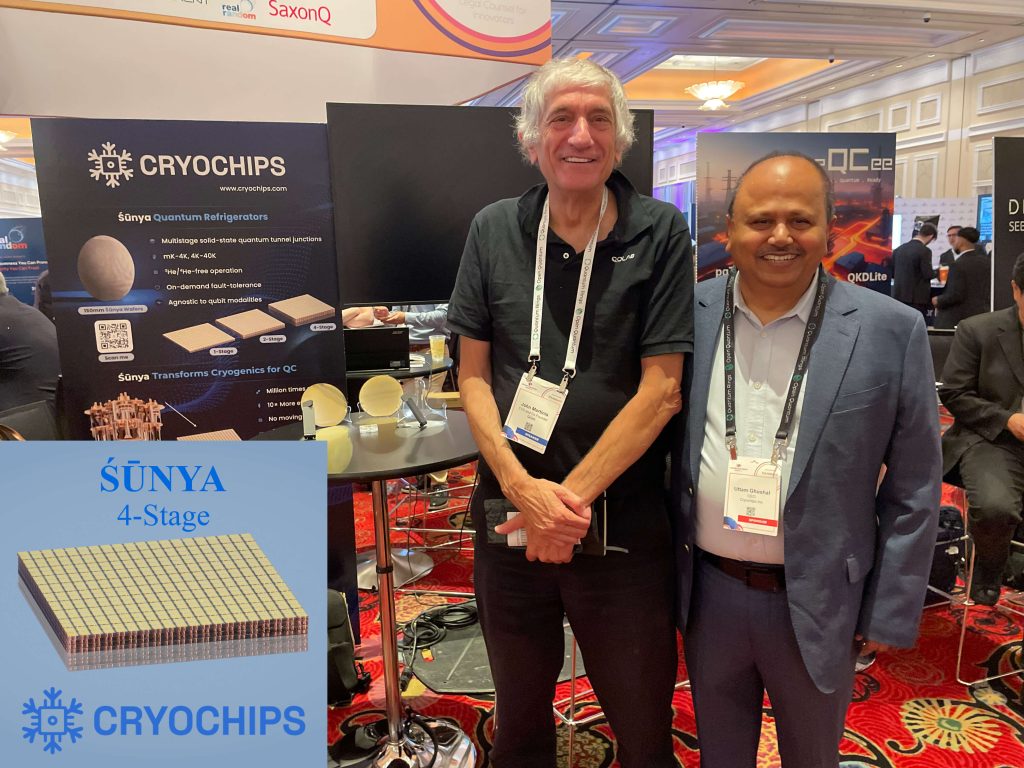
For CRYOCHIPS, the connection is especially meaningful because Dr. Martinis also co-authored one of the pioneering demonstrations of electronic quantum refrigeration.
In 1994, Mark Nahum, Tom Eiles, and John Martinis demonstrated one of the world’s first electronic microrefrigerators based on normal-insulator-superconductor (NIS) tunnel junctions. Their work showed that quantum tunneling could selectively remove high-energy electrons from a normal metal, cooling the electron population below the surrounding lattice temperature. It was an elegant demonstration of how superconducting tunnel-junction physics could be used not only for sensing and computation, but also for refrigeration.
That experiment established an important scientific principle: refrigeration could be achieved electronically, without moving parts or circulating cryogenic fluids.
At CRYOCHIPS, we asked a different question.
How can this elegant physical principle be transformed into a practical refrigeration platform capable of supporting large-scale quantum computers?
The answer is ŚŪNYA.
ŚŪNYA is our patented wafer-scale multistage solid-state refrigeration platform. Rather than implementing a single electronic refrigerator, ŚŪNYA integrates large arrays of tunnel-junction refrigeration elements into a multistage wafer-scale architecture fabricated using semiconductor manufacturing techniques.
The accompanying image illustrates this progression. The four-stage ŚŪNYA architecture represents the commercial direction of the technology. Each stage is designed to cool from the temperature produced by the previous stage, enabling progressively lower operating temperatures within a single integrated platform. The four-stage architecture provides the foundation for wafer-scale refrigeration across the cryogenic temperature range required by future quantum systems.
Our objective is not simply to cool electrons. It is to transform cryogenic refrigeration itself—from room-scale machinery into microfabricated infrastructure integrated directly with quantum processors.
Today, quantum processors occupy only a few cubic centimeters, while the cryogenic systems supporting them occupy cubic meters. We believe that relationship must change if quantum computing is to become scalable, manufacturable, and widely deployable.
The photograph accompanying this article represents more than a meeting between scientists. It symbolizes the evolution of an idea over more than three decades—from pioneering demonstrations of electronic refrigeration to a patented wafer-scale multistage platform designed for the next generation of quantum computing.
This article is the first in our series, “From Foundations to Infrastructure.” In the coming weeks, we’ll explore the complementary breakthroughs in algorithms, hardware, and infrastructure that are shaping the future of quantum computing—and the role CRYOCHIPS hopes to play in that future.